
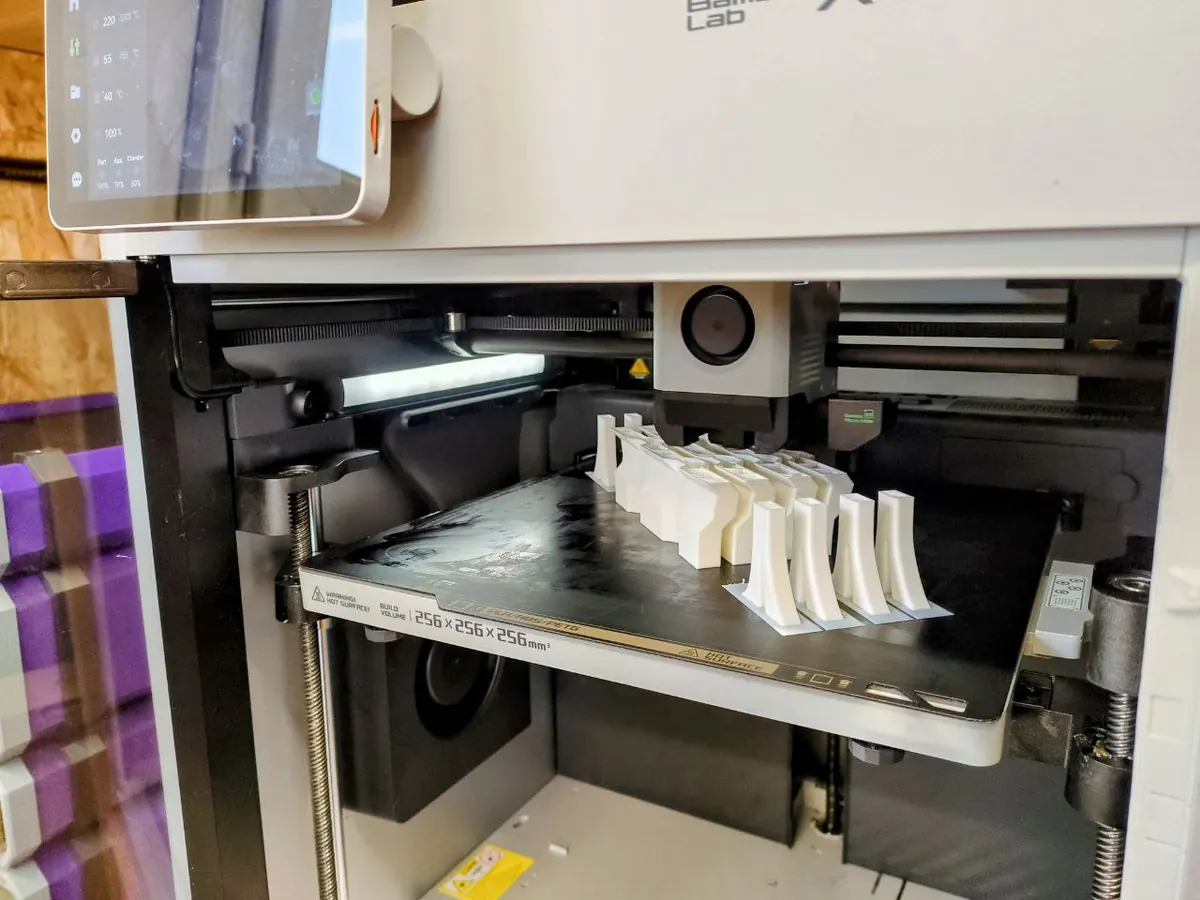
A simple, accessible and effective technology
FDM (Fused Deposition Modeling) is an industry standard: it deposits a molten filament layer by layer. It appeals through its simplicity, its controlled cost and its versatility — and dominates the market for both personal and professional printers.
Meaning and operation
What does FDM mean?
FDM stands for “Fused Deposition Modeling”. It is an additive manufacturing process that creates objects layer by layer, from heated plastic deposited with precision.
How does an FDM printer work?
Everything starts from a 3D file (STL or 3MF) sliced into layers by a slicing software. The nozzle heats the thermoplastic filament until it becomes semi-liquid, then deposits it layer after layer onto the build plate.
Compatible materials
FDM accepts a wide variety of thermoplastics, suited to different uses.
The most common
- PLA — biodegradable, ideal for visual prototypes and mock-ups
- PETG — mechanical strength and ease of printing
- ABS — strong and heat-resistant, but requires a controlled environment
Technical materials
- TPU — flexible, for seals and protective parts
- PA (nylon) — robust, for tooling and mechanical parts
- Filled composites (carbon, glass) — increased rigidity
Why FDM is so widespread
Accessible and affordable: FDM printers are among the most affordable, filaments remain reasonable, maintenance is simple and the learning curve is quick.
Highly versatile: visual or functional prototypes, tooling, mock-ups, technical parts — thanks to multi-material compatibility and design freedom.
What to know before printing with FDM
Precision: the resolution is lower than with SLA or SLS. Layers create striations on curved surfaces; the nozzle diameter (0.4 mm) limits fine details and thin walls (below 0.8 mm).
Supports: overhangs require supports. Good orientation of the model — and sometimes splitting it into several parts — makes printing and assembly easier.
FDM at Osmoz 3D
We use several FDM printers set up according to each project: rapid prototypes, strong functional parts, production runs manufactured locally — up to 500 mm in length, with good repeatability. We also support you on material choice, file checking and technical adjustments (orientation, splitting, reinforcements).
In short, FDM remains the most widely used technology in the world: accessible, fast, versatile, with an excellent quality-to-price ratio.
Going further: see how we use FDM on our FDM 3D printing page.