
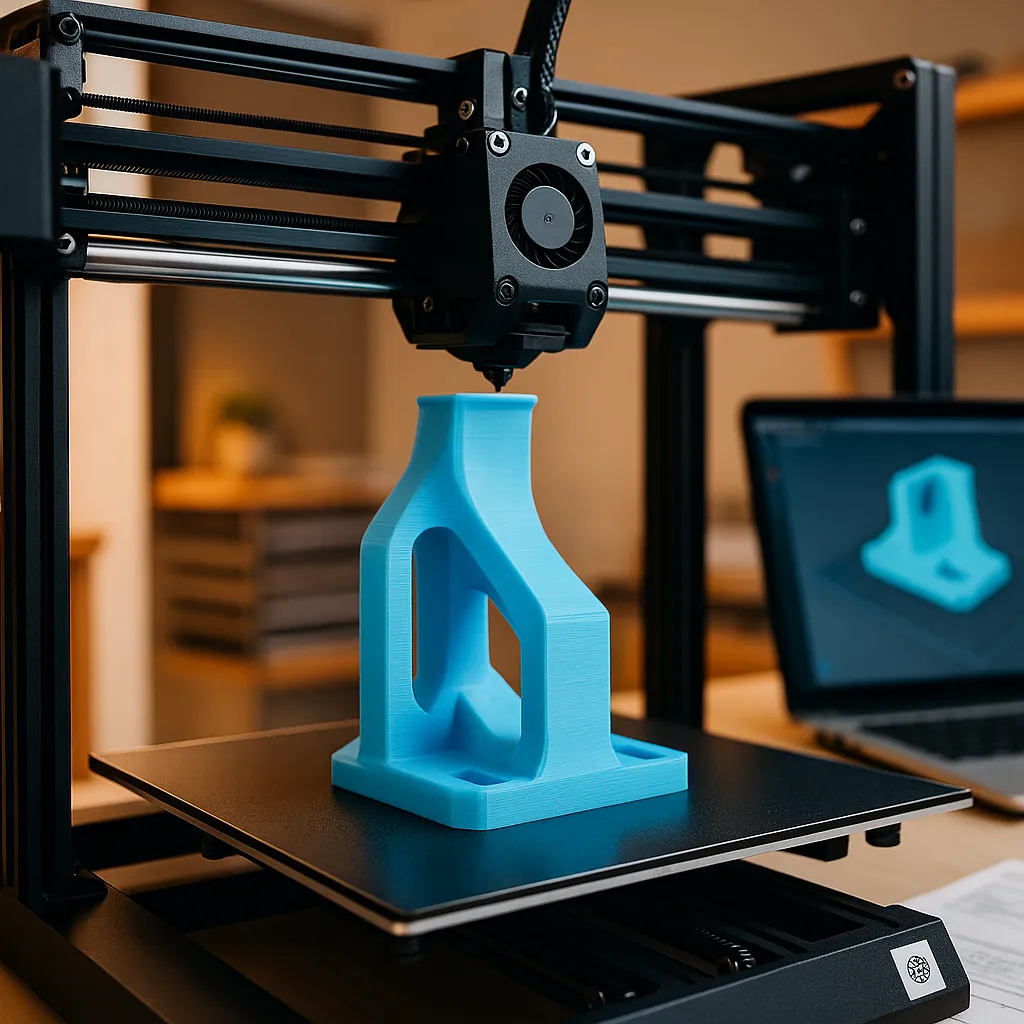
FDM, SLA, SLS: behind these acronyms lie very different additive manufacturing processes — extrusion, photopolymerisation, laser sintering. Each has its strengths, its constraints and its use cases. Here is what you need to see clearly before launching a part.
FDM — fused filament extrusion
FDM (Fused Deposition Modeling) is the most widespread technology. A plastic filament (PLA, PETG, ABS…) is heated until it melts, then deposited layer by layer through a nozzle to build the part.
Advantages
- Affordable and fast
- Compatible with a wide range of materials
- Accessible and easy to maintain
Limits
- Lower precision on small details
- Layer lines sometimes visible depending on the settings
SLA — precision through photopolymerisation
SLA (Stereolithography) uses a light-sensitive liquid resin that hardens when exposed to light (laser or UV). The part is built inside a vat of resin, solidified layer by layer by a very fine beam of light.
Advantages
- High resolution and smooth surfaces
- Ideal for detailed objects: figurines, jewellery, technical components
- Little or no mechanical post-processing
Constraints
- Resins more brittle than some filaments
- Post-processing required: alcohol rinse and UV curing
- Less suited to large parts
SLS — laser sintering for complex geometries
SLS (Selective Laser Sintering) locally fuses a powder using a precise laser beam. The parts form within a powder bed that naturally acts as a support — giving maximum freedom of shape.
Strengths
- Design freedom for complex geometries
- Very good mechanical strength
- No supports to remove
Drawbacks
- Higher cost (machines and materials)
- Grainy finish, often bead-blasted or smoothed
- Often outsourced, less common locally
Which technology to choose for your needs?
The right choice depends on the level of detail you need, the mechanical constraints, the expected appearance, and the volume as much as the budget. In short:
| FDM | SLA | SLS | |
|---|---|---|---|
| Precision | Fair | Very high | High |
| Surface | Visible lines | Smooth | Grainy |
| Strength | Good | Medium (brittle) | Excellent |
| Cost | € | €€ | €€€ |
| Ideal for | Prototypes, mechanical parts | Fine details, optics | Complex shapes |
At Osmoz 3D, we work with FDM and SLA in-house, and we outsource SLS for projects that require it. Understanding these technologies is already half the decision — and if any doubt remains, we will advise you.
Going further: compare these processes in real conditions on our 3D prototyping service.