
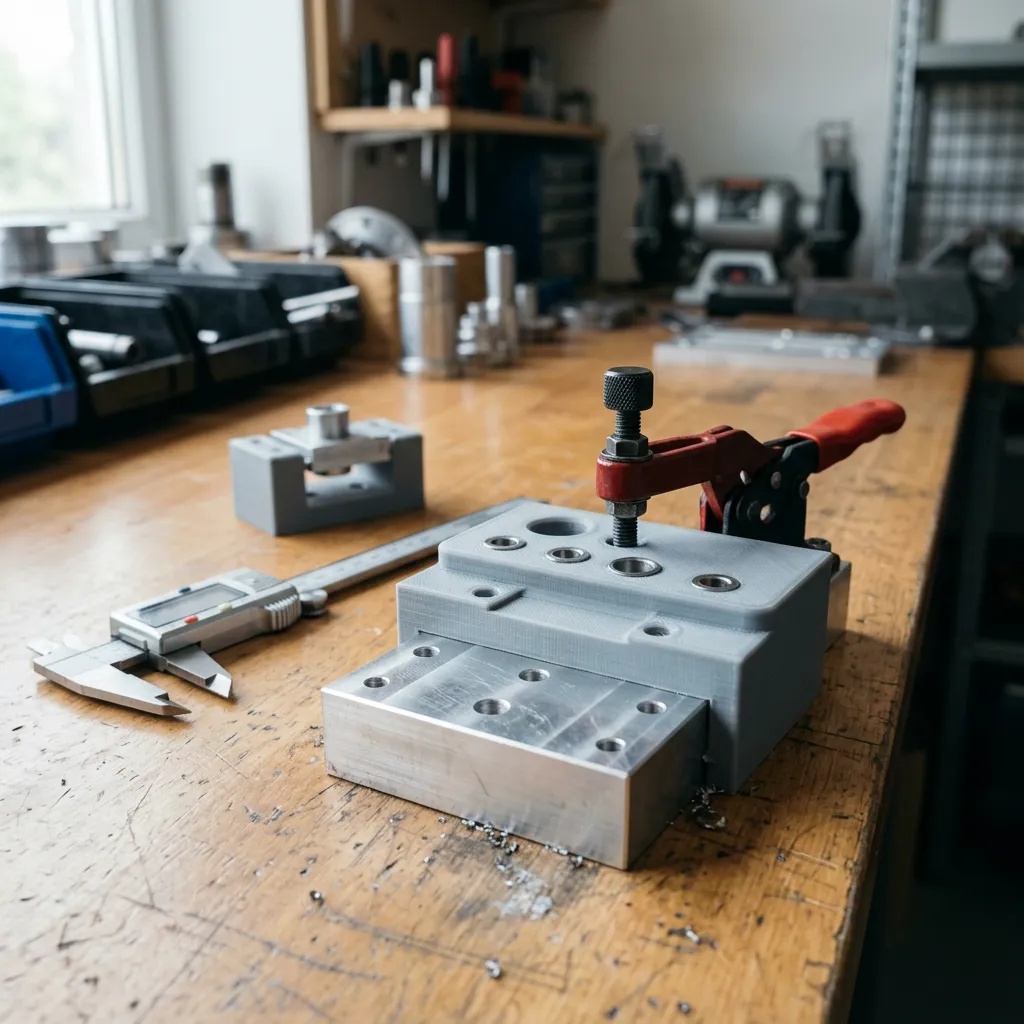
3D printed jigs and fixtures: jig, fixture or gauge?
Before you order 3D printed jigs and fixtures, it helps to agree on the words. On the shop floor, the French word gabarit covers several tools that do different jobs. English separates them more clearly, and telling them apart helps you choose the material and the technology, and write a clear request.
- Jig (guiding or drill jig): it guides the tool (drill bit, scriber, blade) so that the hole or cut lands in the same place on every part.
- Fixture (work-holding, assembly, bonding, welding): it holds the part in position, or aligns several parts, during the operation.
- Inspection gauge: it checks a shape, a position or a dimension, for example a go/no-go gauge.
- Protective pads, shims, soft jaws, holders: they protect a finished part, support it, or store and present a tool at the workstation.
These tools have one thing in common: they are often one-offs, specific to a part or a workstation, and lightly loaded compared with a machine part. Their job is to make an operation accurate and repeatable. That is what makes them worth 3D printing.
Tooling that is worth printing
Good candidates share a few traits: a shape specific to your part, low quantities, moderate loads and a design that is likely to change.
Inspection and locating gauges
The gauge follows the part: outline, nest, stops, reference marks. 3D printing easily reproduces a freeform or complex shape that would take a long time to machine from solid. If the part drawing changes, you edit the model and print again.
Assembly, bonding and drilling fixtures
They hold or guide during a repeated operation. The model can include pockets, reference marks, tool clearances and lightening cut-outs from the start. For a drill jig, the bit should not rub directly against the plastic: plan a seat for a fitted metal drill bushing at the design stage (see "Tolerances and finishing" below).
Protective pads, shims and soft jaws
They stop a finished part from being marked in a vice, a gripper or a fixture. Depending on the need, they are printed in a flexible material (TPU, elastomer resins) or a rigid one. You can also combine a rigid body with a soft contact surface printed separately and then fitted, bonded or clipped on.
Tool, sensor and workstation holders
Tool holders, workstation organisers, sensor brackets, interfaces between two standard pieces of equipment: parts nobody sells, because they depend on your set-up. The reasoning is the same as when adapting a technical part to existing equipment.
Ergonomics and complex shapes
Handles, grips, shapes that follow the operator's movement, hollows to save weight: 3D printing produces these shapes without dedicated tooling, where a machined block quickly makes them time-consuming.
Tooling that is not suited (or not without precautions)
A printed jig is not a cut-price metal tool. Formlabs, a resin manufacturer, says so itself: SLA printed fixtures are not as durable as metal ones and show wear over time. Here are the cases where you should stop, or plan something else.
- High loads or repeated impacts: very tight clamping, striking, pressing. Under sustained load a plastic can creep and deform; metal remains the reference.
- Continuous heat: close to an oven, a welding station, a part that comes out hot. Only some materials are suitable, and only after checking the technical data sheet.
- Heavy friction and wear: a drill bit guided without a bushing, a heavily used slide. Protect contact areas with fitted metal bushings or inserts, or make them replaceable wear parts.
- Very tight dimensions without finishing: if the required tolerance is tighter than those stated as standard on our FDM 3D printing and SLA 3D printing pages, you need machining or another solution. These tolerances are confirmed for each part.
- Aggressive chemical contact: solvents, cutting oils, cleaning products, without checking compatibility first.
- Very large quantities of the same tool: rare for jigs and fixtures, but beyond a certain volume other processes become relevant.
- Safety-critical or certified tooling: lifting, personal protection, tooling subject to approval. Without formal validation, do not print it.
On how printed parts hold up over time in general, see our article on more durable professional parts and tools.
Which material for which tool
The choice starts from the constraint (load, heat, friction, contact with the part, chemicals), not from the catalogue. The table gives leads among the materials we print; the decision is made on the data sheet, part by part.
| Need | FDM option | SLA (resin) option |
|---|---|---|
| Light inspection gauge, tooling mock-up, first iteration | PLA, PETG | Standard resins (Grey, White, Black) |
| Everyday shop-floor fixture | PETG, ABS, ASA | Tough 2000 |
| Higher loads, stiffness, repeated loading | PA (nylon), carbon-fibre filled materials (PETG-CF, PA-CF) | Rigid 10K (glass-filled, very stiff) |
| Friction, sliding | To be assessed case by case | Durable (low friction) |
| Soft contact, soft jaws, non-marring pads | TPU (several Shore hardnesses) | Flexible 80A, Elastic 50A |
| Close to a heat source | ASA, PA, PPA-CF, depending on the data sheet | High Temp, subject to a feasibility study |
| Handling circuit boards | — | ESD, subject to a feasibility study |
| Small precise gauges, fine details | — | SLA resins in general |
FDM or SLA for a jig?
FDM suits large tooling, the widest choice of materials and parts that carry mechanical loads. SLA suits small precise gauges, smooth surfaces and fine details, within a smaller build volume. Build volumes and tolerances for each technology are stated on our service pages. Our article FDM, SLA or SLS compares the three processes; at Osmoz 3D, we work in FDM and SLA.
One rule to keep: service temperature and chemical resistance are checked on the data sheet of the chosen material, case by case. For the method, see choosing the right material for your project.
Questions to ask before you start
Your answers make up the brief for the tool. The more precise they are, the better the chance that the first one is right.
Function and critical dimensions
- What does the tool do: guide, hold, check or protect?
- Which surfaces are functional (bearing faces, stops, nest) and which are free? Anything non-critical can be lightened.
Loads
- Clamping, tightening, bearing, impacts, vibration: how strong, and in which direction?
- In FDM, a part is weaker between layers than within them: the print orientation is decided according to the loads, at the design stage.
Temperature and chemicals
- Hot part, welding, curing oven, exposure to sunlight?
- Contact with oils, solvents, cleaning products?
Tolerances and finishing
- What tolerance is really needed, compared with those stated for the technology you have in mind?
- Do you need threaded inserts, metal bushings or dowel pins? Their seats are planned in the model.
- Are there areas to be machined or sanded afterwards?
Service life and wear
- How many uses per day, and how will wear show?
- Do you need replaceable wear parts, or a second copy of the jig?
Number of copies
- A single jig, or one per workstation, per line or per site?
- The same file is used for every copy: handy for equipping several workstations with the same tooling.
Files and inspection
- Do you have the 3D model of the part the tool will receive, for example as a STEP file?
- Does the jig need designing? A dimensioned drawing, a sketch or the part itself can be the starting point for our 3D design service.
- If it is used for quality control, how will the gauge itself be checked before it goes into service?
How Osmoz 3D can help
- Start from the need: you describe the operation, the part and the constraints; the questions above serve as the brief.
- Design if needed: we model the jig from a dimensioned sketch, a drawing or an existing part, and deliver STL and STEP files.
- Choose the technology and the material: FDM or SLA depending on the constraint, with a feasibility study for certain speciality resins.
- Manufacture: from a single unit to a small batch, with assembly and insert fitting where needed.
- Study upstream any tooling at risk (loads, heat, tight dimensions) as part of a technical project study.
We work from Isigny-sur-Mer, in Normandy, and mostly remotely. To get a tool started, describe your need in the quote form.
In short
Print what is specific, lightly loaded and likely to change: inspection gauges, assembly fixtures, protective pads, holders. Keep metal for high loads, heat and heavy wear, or combine the two with fitted inserts and bushings. Choose the material from the constraint and its data sheet. And prepare your answers to the questions above before asking for a quote.
Going further: for demanding tooling, see our technical project study. Context: the jig as a tool.